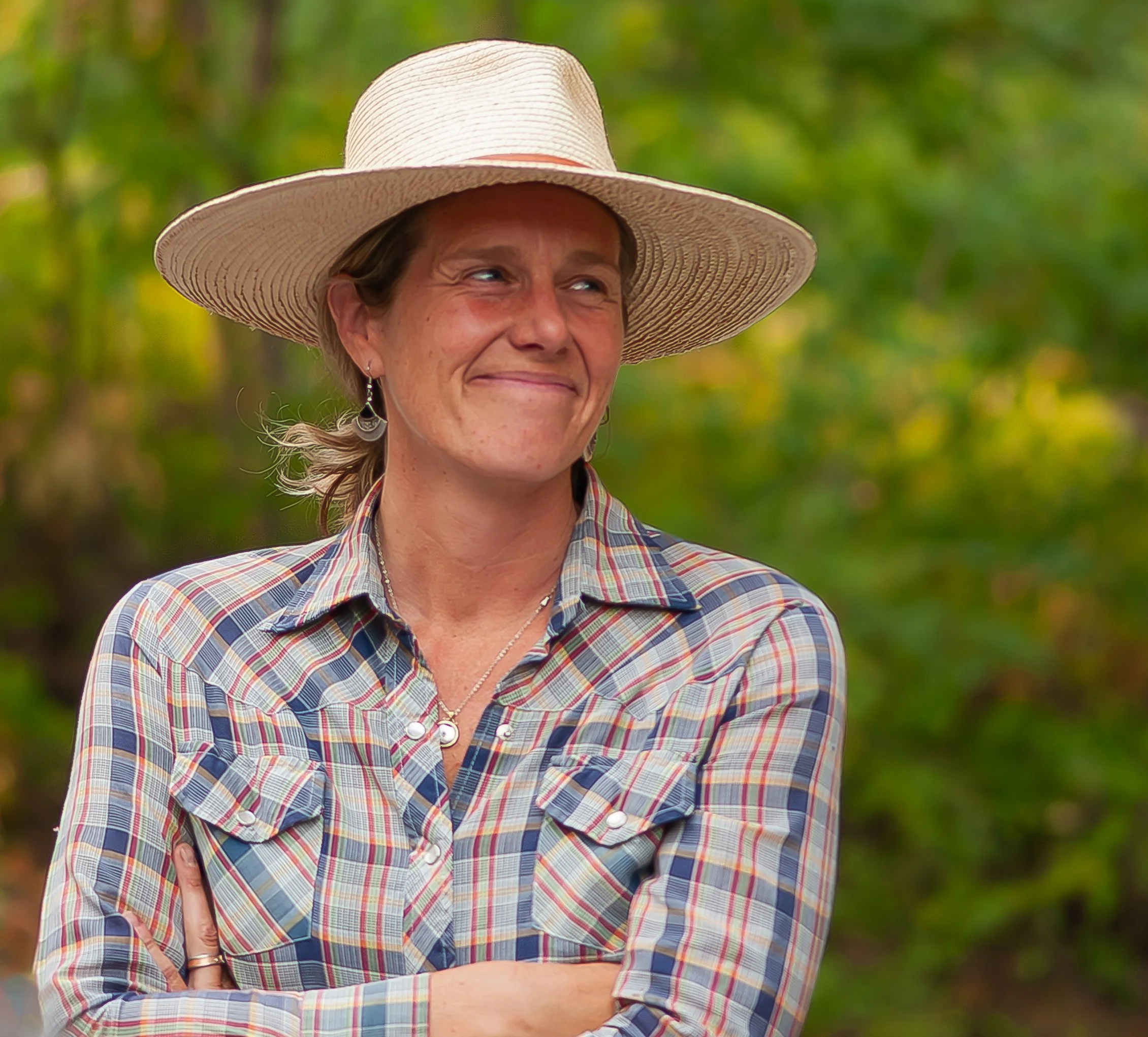
Meet our Educators: Ashley Ahearn

Ashley ahearn

Professional Podcaster and Creator

Winthrop, WA

August 29th — September 6th, 2025

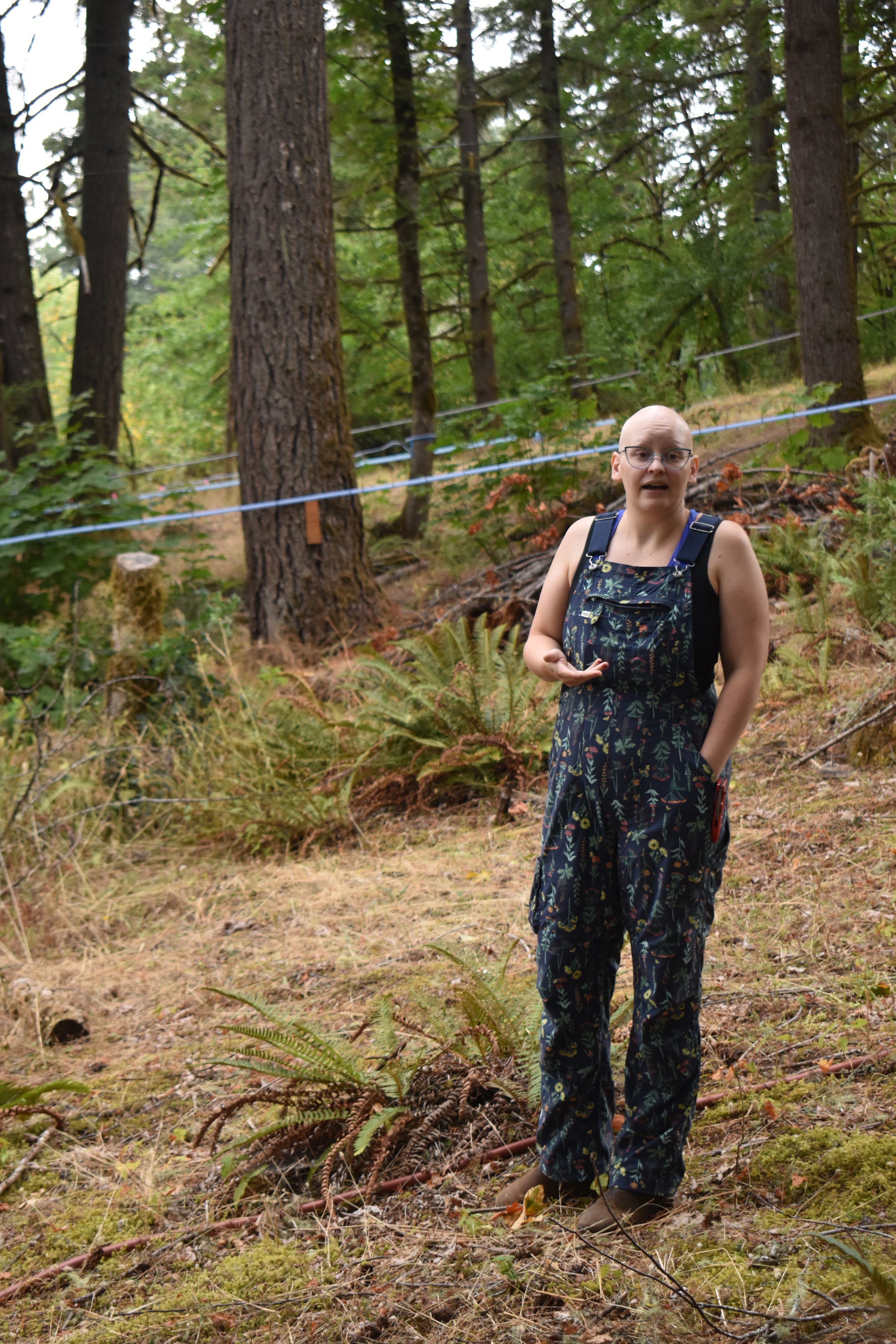
Waking up on Ashley Ahearn's property for the first time was stunning. The expanse of the valley stretched out below us with sun slowly reaching overhead, and a view of the cascade mountains peaking up behind. Throughout our nine days in the valley Ashley opened up her home, letting us use her beautifully converted grain silo, introducing us to her friends and animals, and taking time to teach us the art of podcasting.

We all squeezed into her outfitted grain silo to escape the heat, and she introduced us to her most recent podcast Mustang. We were able to look over her script and she showed us how important ambient noise can be, because it turns out getting the audio of a car door closing, and someone saying hello can be the perfect opening for a podcast. We also industry jargon sayings such as “getting to the heart tape”, and “garbage in garbage out”. 

We were able to practice these skills when she introduced us to Paul Myrick, a Methow descendant, and her long friend and cattle rancher, Deed Fink. In a one week crash course we were able to produce a five minute podcast!

by Katharine Graham
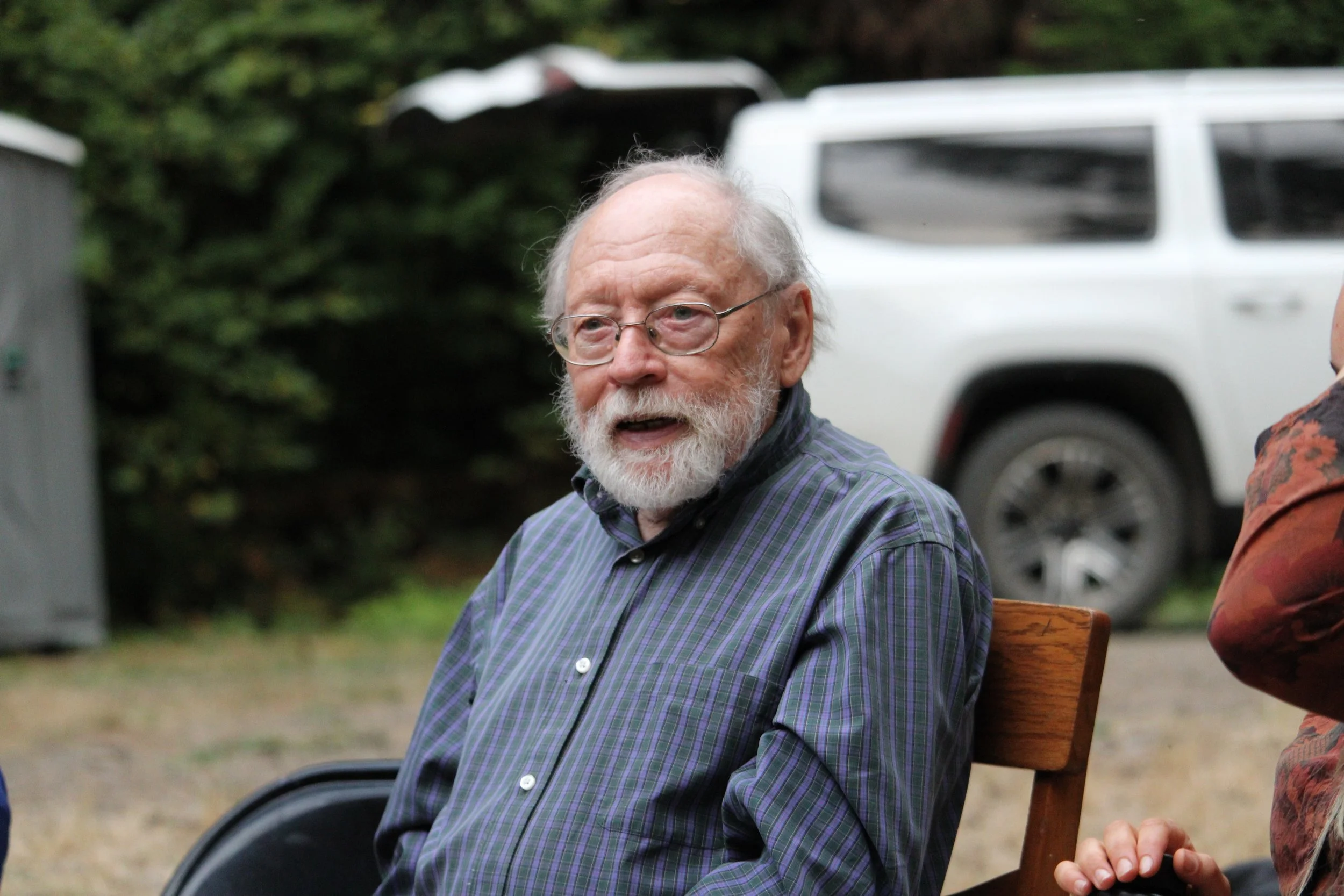
Meet our Guests: Donald Worster

donald worster

Environmental Historian of the American West and Planet Earth

HJ Andrews Experimental Forest, OR

August 27th, 2025

“Guilt is not what I’m after. I’m after understanding,” asserts Donald Worster, one of the founders of the environmental history field and Professor Emeritus of History at the University of Kansas. As we explore the American West, Worster’s lecture is currently the top contender for generating controversy among the students. He believes that guilt, an essential component of Judeo-Christianity, does more harm than good when it comes to protecting the environment of the American West.

In Judeo-Christian belief, when one is guilty they are driven to seek redemption, and when applied to western environmentalism this means returning the West to the state it was in before the “white man” arrived. Worster calls this religious historicizing “sacred history”, which is the belief that before European civilization, nature was in a divine state, and since civilization this perfect state has been disrupted. Worster wants us to understand that humans are a part of nature, and in the future, as the Earth is changing and resources are decreasing, humans will learn to live with less.

Worster’s personal experience and educational background have influenced how he views the history and future of the American West. He maintained a graduate degree from Yale University where he received “an Easterner’s view of the West,” leading him to pursue the history of the West from the perspective of Westerners like himself. He is a current board member of the Land Institute at the University of Kansas and served as the president of the Western History Association.

Worster’s argument inspired many passionate debates among students. Some lasted through the night (with small breaks for meals). Students questioned how we could simply forget the guilt that comes from a history of trauma in the American West and what the realities of the future are.

by Lucy Brown

Meet our Guests: Mark Schulze

mark schulze

Director of the HJ Andrews Experimental Forest, Assistant Professor, and Senior Researcher at Oregon State University

HJ Andrews Experimental Forest, OR

August 26th, 2025

Nestled deep in the Willamette National Forest of Central Oregon, the H.J. Andrews Experimental Forest sits as a pivotal center of Northwest Forest research. Mark Schulze serves as the director of research in this forest, where groundbreaking science meets the humanities. As one of the 82 designated experimental forests and rangelands in the United States, the Andrews Forest originally was designated to examine the effects of logging operations on environmental factors in forests, as well as to inform management policy on federal forest land.

Mark showed us several research sites and regaled us with the rich history of the Andrews. He was excited to speak about groundbreaking research conducted by Jerry Franklin, Mark E. Harmon, and several others, who discovered fundamental knowledge about the role of dead wood, endangered species, carbon sequestration, and old-growth forests. The research conducted at the forest led to the site being selected as one of 26 in the National Science Foundation’s Long-Term Ecological Research Program (LTER). It also informed the Clinton-era Northwest Forest Plan (1994).

As director, Mark’s job is to strike a balance between conserving the forest and implementing active management, as well as determining which experiments are conducted in the forest. He showed us a sediment catch basin site. He emphasized the need for adaptive management strategies, as well as the importance of minimizing the impact of fire and logging on forest ecosystems..

Thank you, Mark, for taking the time to show us around the Andrews Forest. It’s exciting to learn about the groundbreaking research being conducted here!

By Trevor Maziek

Meet our Guests: Fred Swanson and Julia Jones

Fred Swanson and Julia Jones

Research Geologist and OSU Professor of Geography

HJ Andrews Experimental Forest, OR

August 26th, 2025

Semester in the West had the great privilege of spending an early afternoon with OSU Professor of Geography, Julia Jones, and research geologist, Fred Swanson. Incidentally, Julia and Fred are the parents of two children that graduated from Whitman. Fred, now retired, worked for the U.S. Forest Service for forty years as a geologist often combining his work with ecology, especially the death side of ecology that he feels many people tend to overlook. His partner in science and in life, Julia Jones, has been a professor of geography at Oregon State University for just as long, with a truly impressive knowledge of ecology and geology that goes far beyond what one might typically think of as geography. They took time out of their afternoon to drive up from their hometown of Corvallis, Oregon, meet us at the Andrews Experimental Forest two hours to the southeast, and lead us on a guided workshop where we Westies had to use our own detective skills to interpret what was happening in the forest around us and strengthen our ability to read the land. While sad to part so soon, we Westies are truly grateful for the opportunity to put into practice all the skills we’ve been learning outside the classroom, and we deeply appreciate Fred and Julia for taking the time to guide us through the process of science.

by Hollis Wilson

Meet our Guests: Eric T. Jones

eric t. jones

Professor, Oregon State University, College of Forestry

Springfield, OR

August 25th, 2025

Tucked away in the suburbs of Eugene, Oregon, we explored all that goes into the small industry of maple taping in the Pacific Northwest. Walking through a winding path surrounded by Big Leaf Maples on either side of us we entered a greenhouse to learn about the collection process of maple sap. Eric T. Jones, professor at Oregon State University in the College of Forestry, has dedicated himself to developing a network of maple syrup producers on the west coast.

Born and raised in Salem, Oregon, he has always been surrounded by the large timber industry. Trained as an anthropologist, Eric has spent most of his career studying non-timber forest products, beginning with understanding the commercial viability and the cultural significance of such products.

Eric has continued to explore other types of non-timber forest products, including Oregon Grape, an important wildcrafted herb. Notably, he played a pivotal role in creating the market for maple syrup in the Pacific Northwest, which has included the creation of Oregon laws to make it possible for non-commercial companies to sell their syrup.

by Ashley Hagen

Meet our Guests: Brian and Blair Kearney

Brian and Blair Kearney

Mohawk Valley Maple

Springfield, OR

August 25th, 2025

Tucked away in Mohawk Valley, Westies met with Brian Kearney and his daughter Blair Kearney to learn how and why they are producing maple syrup from Big Leaf Maples in Oregon and not New England. The maple industry in Western North America is a relatively new production that has faced challenges due to the milder climate here. In partnership with anthropologists Eric Jones and Oregon State University, Brian spent the last two years establishing a process for maple syrup production specific to the region. Brian’s daughter Blair joined his project and has started tending for the land as well. In this experience, Westies learned about sugaring technique experiments that Brian’s been conducting to find the most efficient and productive methods that will sustainably supply maple syrup. With the findings, they’ve prioritized reciprocating the syrup opportunity with the local community and the larger maple syrup industry by reaching out to share resources and knowledge.

Brian got into the maple syrup industry to utilize the native Big Leaf Maple trees. These native trees often grow in riparian areas meaning that tapping them protects the river’s ecology and lets private landowners profit from otherwise marginal economic zones. This sustainable practice thus aligns many values. From syrup to mushroom growing to the forest greens market, there are many products in the West that can be obtained using sustainable land management. It was intriguing for us to learn about the various opportunities the forest holds outside of timber and see Brian and Blair's optimistic attitudes about their new maple syrup production.

by Zandra Bakken

Meet our Guests: Heath Curtis

Heath Curtis

Vice President of Legal and Government Affairs, Hampton Lumber

Portland, OR

August 24th, 2025

On a balmy Sunday morning, as the sun begins to creep over the Douglas Firs and Oregon White Oaks of the Zena Forest, Heath Curtiss graciously sits with us in the chair circle to discuss his instrumental part in the creation of the Private Forest Accord, a historic agreement between lumber companies and conservation organizations that brings benefits to both timber companies and environmental groups.

Heath explains how his youth spent hunting and fishing in Montana helped nurture his immense love for nature. He goes on to describe how he quickly saw nature not only as a place to recreate, but as a means to make a living.

A delicate balance can be achieved between conservation and resource use in forests, and Heath is committed to overcoming the ways timber companies and conservation groups have deadlocked in the past. Heath argues that this impasse does more harm than good, and often leads to a black and white solution in a very grey area in today’s environment. Passionate about his neighbor’s ability to make a living, but also about preserving forests for generations to come, he tells us about his role in brokering compromise.

By playing a crucial role in the development of the Private Forest Accord (PFA), Heath worked to find common ground between opposing sides. The PFA mitigates the timber industry’s effects on streams and their resident organisms by increasing stream buffers and implementing a more environmentally-conscious pesticide application system. In return, the timber industry receives immunity from EPA lawsuits concerning the endangered species act, leading to more stable regulation surrounding their business.

Heath left us with the final thought that everything has tradeoffs, especially in his line of work. However, if both sides are willing to sit down and have difficult conversations, everyone can walk away in a better place than where they started.

By Griffin Arnett

Meet our Guests: Ben Deumling

ben deumling

Zena Forest Products

Willamette Valley, OR

August 23rd - August 24th, 2025

Ben Deumling is a forest steward, a Whitman Alumni, and the owner of Zena Forest Products. As the first guest of our group, we were excited to see Ben waving with a big smile after our long drive from JWC to Zena Forest, 9 miles away from Salem, Oregon. Ben was in the very first Semester in the West cohort, and like many former Westies who came to visit us here, Semester In The West was a foundational experience that influenced his environmental philosophy today, which informs the decisions he makes at Zena. We went on a walk that afternoon under the scorching late August heat, as Ben warned us to watch out for the poison oak sprouting everywhere along the trail.  He showed us other species in the forest and their interactions as well.


Ben founded Zena Forest Products soon after having completed SITW the second time as a staff member. Westies had the chance to visit his warehouse where hardwood flooring is sourced from Oregon white oak, often deemed as not economically valuable as Douglas fir that is also widely grown in the region. Together with his mother Sara, Ben showed us Zena sustainably logs and grows forest.  They also shared with us the challenges of invasive blackberries and a fluctuating timber market. Westies appreciated the evening conversations at the chair cycle (colloquially known as 'the chircle'), about the history of the land and how Ben comes to see his role and dedication in the stewardship of this forest.

by Linh Che

Meet our Guests: Casey Kulla

Casey kulla

State Forest Policy Coordinator, Oregon Wilds

Willamette Valley, OR

August 23rd, 2025

Casey Kulla is a former Yamhill County Commissioner who joined Oregon Wild in 2022 from Corvallis, OR. He is passionate about forest policy and how timber practices impact all communities, especially the coast ranges where people experience water shortages.

Casey led us in discussion about the National Environmental Policy Act (NEPA) and how it could be improved or changed. He encouraged us to share our knowledge with each other and learn about unique ways of combating water issues through things like recreating beaver dams or engineering better stream retention into watersheds. While we spoke, Casey and the students fled from the sun, seeking shade and cooling themselves by drinking water, accentuating the weight of how important water is, particularly in dryer areas like the Willamette Valley.

Casey is excited to start law school after a long career in NGOs and public service. He reminds us that learning happens at all stages of life. As the sun began to set, Casey departed, leaving us with new ideas about the relationship between water and timber, and the importance of policy that listens to all voices.

by Katherine Finger

Meet our Guests: Sarah Deumling

Sarah Deumling

Forest Manager, Zena Forest Products

Willamette Valley, OR

August 23rd - August 25th, 2025

Rolling into the Willamette Valley, sun blaring uninhibited through a cloudless sky, we were welcomed to our campsite in Zena’s forest by two towering chestnut trees, clusters of cow parsnips, and Sarah Deumling wandering towards us with the dust from her four-wheeler at her heels.

Although short in stature and soft in her speech, Sarah’s impact on our group and our understanding of western forest management was anything but small. Over the course of two days, Sarah would chronicle her journey to Zena intermittently, nestled between bouts of giggles and chitchat. Having purchased the land in 2008, the Deumlings sought to protect the forest from unsustainable logging practices and potential commercial development. Following the passing of her husband, Sarah stepped up, taking charge of stewarding the land and managing the timber company.

Sarah emphasized how inexperienced and out of her element she felt in the face of such a daunting amount of responsibility, having adored the forest prior not as the focus of her job but as a wandering place where her beloved trilliums grew in abundance. Though she detailed her relationship with Zena’s forest since taking over as forest manager with immense humility, it was clear to us all how incredibly creative, careful, and conscious Sarah’s attention to the forest was and continues to be. Sarah has sought to lean into every facet of the forest’s deeply rooted biodiversity; for instance, she was one of the first in western Oregon to utilize the “nuisance” Oregon White Oak in timber markets, manufacturing the dense and sturdy wood into high quality floorboards. In ways such as these, Sarah and her son, Ben Deumling, seek to live in the cross section of ecology and economy, searching for innovative ways to care for the forest sustainably whilst still growing their business. For Sarah, although there continues to be tension between the two, she believes both can coexist, and demonstrates this beautifully in her stewardship of Zena’s forest. Even as forest manager, Sarah ensures me that she “still knows where the wildflowers grow.”

by Marina Roberts