
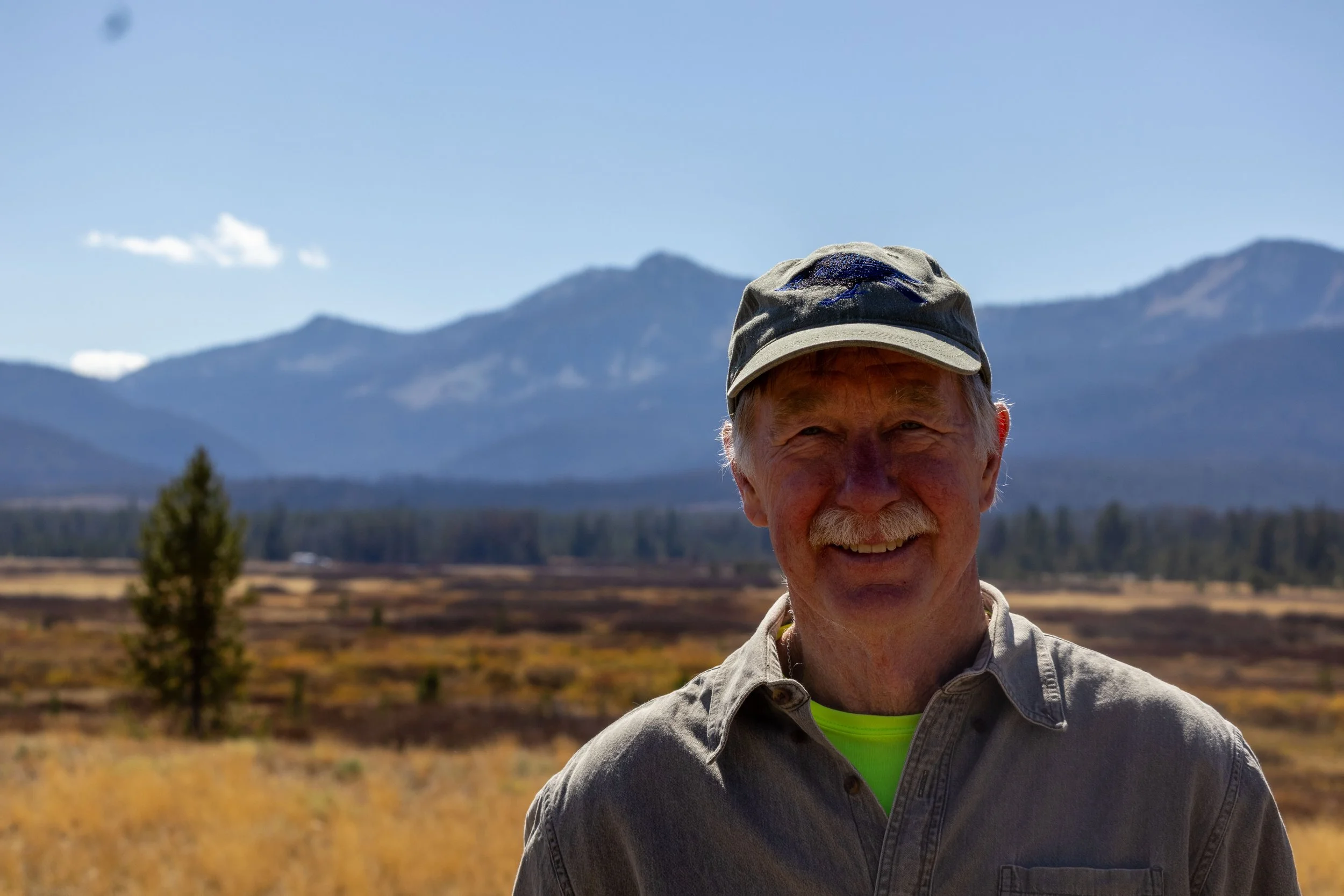
Russ Thurow
Emeritus Fisheries Biologist
Stanley, Idaho
September 20, 2024
In a circle of chairs nestled in the hills of the White Clouds Preserve in Central Idaho, Russ Thurow points at a Mountain Bluebird perched atop a nearby fencepost, its feathers ruffling in the wind. As an Emeritus Fisheries Biologist from the US Forest Service Rocky Mountain Research Station, Thurow joined our group to speak about salmon, the watershed they inhabit, the ecology that connects them, and the dams that divide them. Raised on a farm in rural Wisconsin, Thurow was introduced to a sense of wonder of the natural world at an early age. When he visited a navy shipyard with his father, instead of looking at the ships, he was drawn towards the starfish peaking out as the tide receded. From that moment on, he told us, he knew he wanted to be a biologist.
We traveled as a group through the charred and twisted trees of the Wapiti Fire, which had burned just months before we had arrived. We arrived at a large marshland split by a meandering stream, with the Sawtooth Mountain Range poking up in the distance. Short golden and red willows swayed and flickered in the wind, ends gnawed to a point by beavers. Thurow walked along the waters’ edge, eventually stopping to point out the outline of a salmon “redd” in the creek, a small pocket of gravel constructed by a female salmon as a spawning ground. He described the process of making such a structure, often breathlessly, as if he was watching them swim in front of his eyes. "I've tried to make them before with a shovel, and boy is it hard work. The female salmon does it all with her tail, right before spawning.”
Describing the importance of the species, Thurow said "These salmon are a part of who we are as a nation." He emphasized their significance to the tribes, to the fisherman, to the economy of the state of Idaho, to the delicate ecosystems, and their inherent natural value as beautiful animals. "[Senator] Mike Simpson called them 'One of God's most amazing creatures,’ and I think that's pretty accurate." One student asked about one of the hardest parts of his job. Thurow thought for a moment then said, "When the female salmon make it all the way back to their spawning grounds, through the whole ocean and the dams, and then die before being able to lay eggs…passing through dams tire salmon out, and sometimes, they don't have any energy left."
Ecologically speaking, in order to maintain a healthy and fluctuating population of salmon, a Smolt-to-Adult Ratio (SAR) of 2.0 is needed, so that newborn fish can repopulate those lost. Currently, the average SAR for Chinook Salmon at the upstream-most dam on the Snake River, the Lower Granite Dam, is sitting roughly at 0.7. When asked about what might happen if the Lower Snake River Dams stay in place, Thurow gave us the hard truth. "By the time my two-and-a-half-year-old granddaughter graduates high school, salmon in the Snake River Basin will be extinct."
Work done by Thurow throughout his career suggests that if the four Lower Snake River Dams were to be removed, populations could rebound four-fold. "Snake River Salmonids can't be recovered with eight dams in place. With only four, it's possible." Despite the immense task of actually having the dams removed looming over him, he never loses hope. Seeing their persistence and determination to leap waterfalls and cross oceans, he feels inspired. To continue fighting, just as they do. "Salmon never give up,” he said, “so neither do I."
by Henry Anderson