Ryan Garrett
Education Director at Mono Lake Committee
Mono Lake, CA
October 4th - 5th, 2025
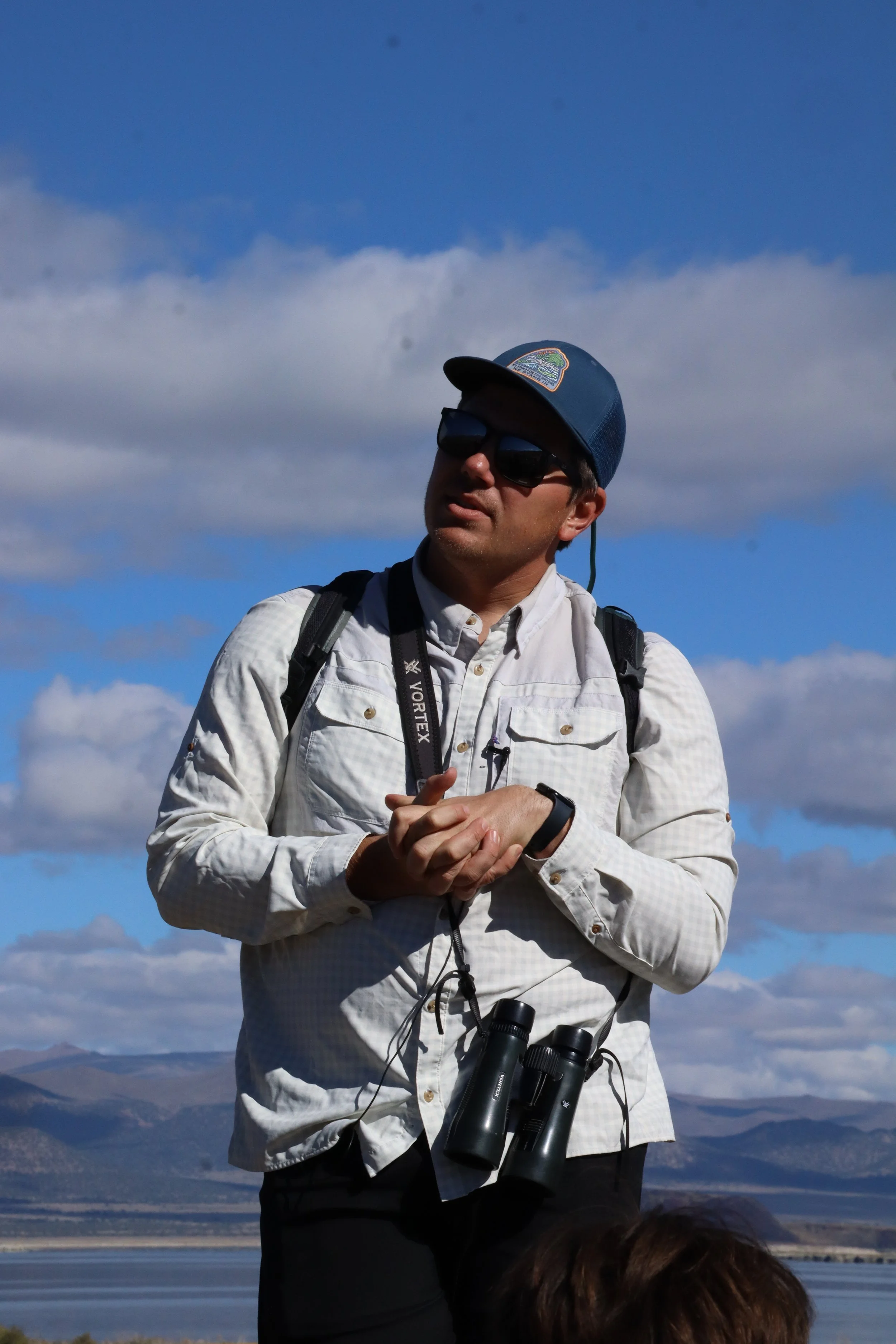
Wearing a Mono Lake Committee hat and a smile, Ryan Garrett greets us in his element, in front of the pale blue Mono Lake. Ryan graduated from Whitman College in 2018 and is now the education director for the committee. He expertly guides us through the basin, its different headwaters, and the complex ecological and political history of its water.
Mono Lake Basin is at the center of many ranges, shadowed by the Sierra Nevada’s, and surrounded by the Bodie Hills, Cal Track Mountains, and Mono Craters. Being at the center, Mono naturally collects water that flows down from these ranges and, over thousands of years, has accumulated salt, forming a saline lake. As salty as it is, the Mono Basin is an extremely ecologically diverse place. Ryan identifies each bush we pass and bird that flies by, emphasizing their importance in not only the environment but the fight to save Mono Lake as well.
On the geological time scale, the fight for water in Mono is a blip in time, but in the Mono Lake Committee's history, it has been a lifelong effort. Since the 1900s, the Los Angeles Department of Water and Power (LADWP) has been diverting water from the Eastern Sierra Valley region via aqueduct for the use and growth of the city of Los Angeles (LA), 331 miles away. In 1941, four out of five water sources of Mono Lake were diverted to the LA aqueduct as the first lake LADWP had diverted, Owens Lake, ran dry. Due to these diversions, Mono Lake’s water level dropped 45 vertical feet. This loss has emphasized the uniqueness and importance of Mono Lake. Tufas, fossilized freshwater springs that had formed underwater due to Mono’s chemical composition, as well as the shore, were revealed. Although beautiful and tourist attracting, this sight is unnerving, a sight only visible because of the water recession. The loss of water also increased the salt concentration, making Mono Lake a more extreme and inhospitable place for endemic brine shrimp and alkali fly species. These small creatures are the foundation of the ecosystem for many visiting and local animals. Mono Lake is a part of the Pacific Flyway, a stop for migratory birds to rest on tufa and feast on shrimp before continuing their long journey south. They also play an important historical role for the Kootzadaka people of the Mono Basin who harvested the alkali fly pupae for food and trading.
Today, these factors matter all the more in saving Mono Lake. The Mono Lake Committee has continued tirelessly working with all actors of this water issue. Through their work and collaboration, Mono Lake only provides 2% of the city of Los Angeles' water, taking less than historically, even as their city population continues to grow. In the future, they hope to meet with all organizations to reevaluate their balancing system of use and preservation.
by Rio Burk