A brown sign with bright orange lettering protrudes from the understory alongside the road. “Only YOU can prevent forest fires,” it reads. Smokey Bear stands proudly next to those words with a smile that says, “I’m here to protect the forest from all harm.” Smokey Bear has become an icon, serving to inform and educate the public. He is beloved by kids and looked up to by adults. Yet what made him truly remarkable is the impact that he had on changing public opinion about forest fires, creating a very convincing, yet inaccurate narrative that forest fires are entirely unnatural and harmful to the ecosystem.

Since its inception, the United States Forest Service has been working to eradicate forest fires, and their Smokey Bear advertising campaigns effectively spread misinformation about forest health. The Forest Service created a zero tolerance campaign, since they believed fires were a waste of lumber. Trees, they believed, were meant to be logged – and if they burned, no profit could be made. However, through suppression of fires for many decades, “fire debt” has accrued. Fire debt is a term used to describe the impacts of going multiple years in a forest without fire. Fire is a natural part of the forest ecosystem, and when a forest goes without fire, flammable material accumulates. Inevitably, whether manmade or naturally ignited, a fire will come through – and when it does, the “fire debt” that has accrued will cause the fire to reach higher temperatures, and cover more acres making it even more destructive.

While in Durango, I saw the aftermath of the 416 fire, which burned 54,120 acres. The impacts of this fire were vast and many trees burned – yet some survived. Trees that are native to the ecosystem are fire-adapted. Ponderosa pine has thick bark allowing it to burn on the outside yet while the interior remains unharmed. Lodgepole pine, another native tree, is only able to sprout after a fire has swept through, creating the disturbance needed to seed.
The best way to prevent large-scale fires is to allow forest ecosystems to burn more frequently. Forest ecosystems are built to withstand regular fires, yet the Forest Service changed public perception, which led to a misrepresentation of what is natural for a forest. As the narrative surrounding forest forest has slowly changed to acknowledge the harm that suppressing fire can have prescribed burns are becoming increasingly more common.
Though not a forest in the colloquial sense of the word, the reality of almond orchards in the central valley of CA are also being influenced by public perception.
“A gallon of water is needed to create a tiny little brown seed.” This blanket statement about almonds was used to persuade the American public to drink less almond milk. At the peak of their popularity, this “fact” was an easy way for competitors to frame almonds as harmful to the environment. It was first brought to the public’s attention in an article in Mother Jones magazine. “Hipsters,” to quote the term used in the article, “Stop drinking all that almond milk.” Dialogue around this article caused almond consumption to plummet. Almonds became known as the water sponge of the west.In the long term drought that California continues to face, Almonds are one of the most commonly cited scapegoats.
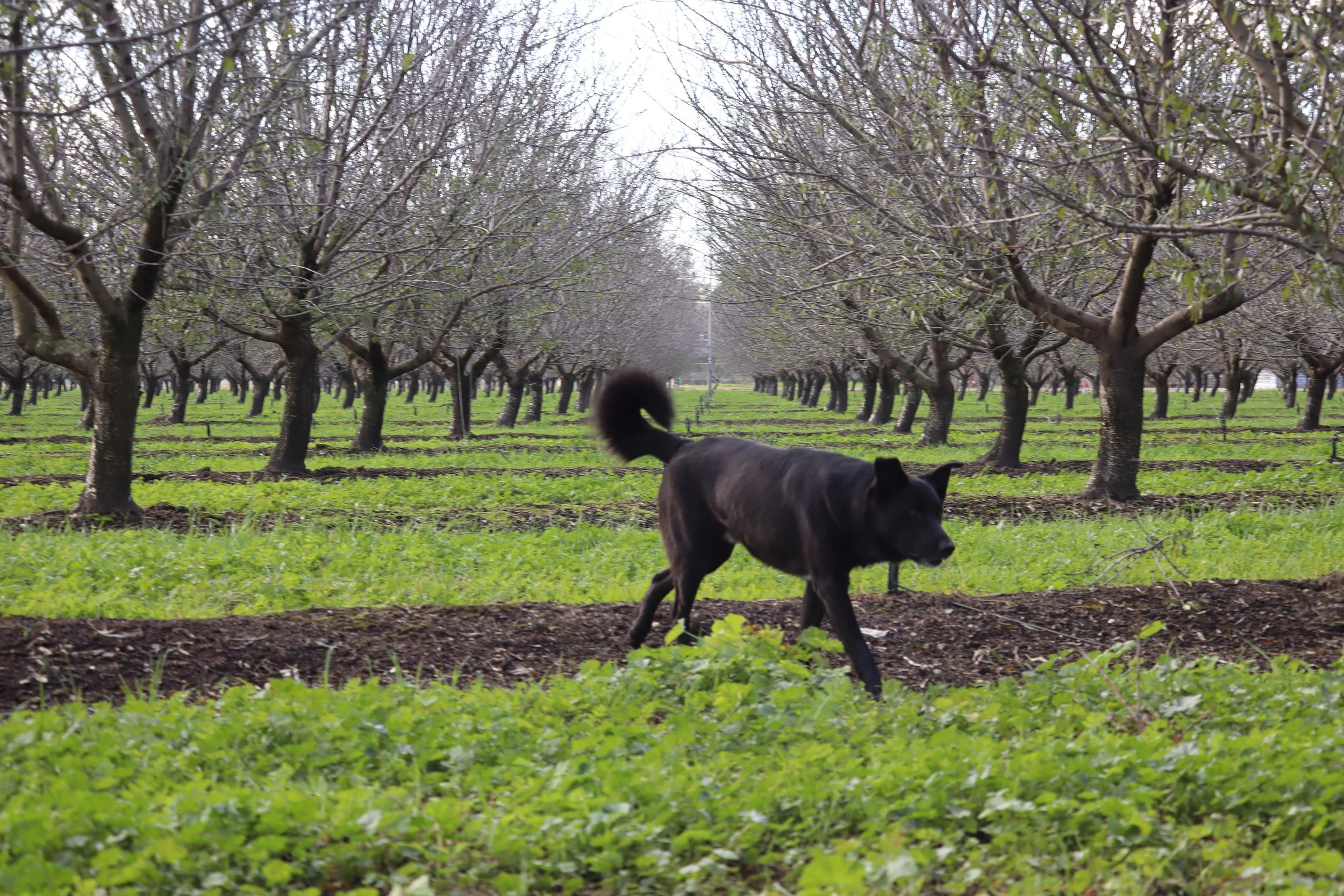
We met with Christine Gemperle in Ceres, California, in her almond orchard, where mustard and clover grew in between each row of trees and a beautiful wild hedge bordered the sides. Birds chirped loudly and her four dogs ran circles around me. I pictured the water pouring into each row of trees, soaking up this valuable resource, all for a nut we could live without. Yet, as we stood in the middle of the orchard, I learned how these trees incorrectly became the poster child for water wastage in the west, through a manipulation of information.
One gram of beef uses four gallons of water, four times as much water as almonds. Christine combated the almond narrative stating that almonds are shelf stable, high in nutrients, and every aspect of the almond has a purpose. Almonds are not wasted, they are non-perishable. Peaches, watermelons, and tomatoes, all high water users often don't make it to market in full yield due to their limited shelf life, and bruising. Almond farmers are researching uses for all aspects of almonds. Hulls, which are a soft pulpy casing covering the almond, are now used in poultry feed and can provide protection against salmonella. Almond shells, the hard outer covering, are being used for bioethanol fuel, a renewable fuel source.
Forest fires and almond farming, although seeming unrelated, have both been impacted by public perception, based on a narrow or incorrect narrative. Prior understanding of forest fires still impacts our woodlands today as we continue to live with fire debt. Reducing consumption of almonds seemed like an easy fix to address California’s drought, yet water use in the west remains a serious issue in agriculture, with consumers choosing to focus on simple solutions without understanding the broader problem. Perceptions can cause lies and misrepresentations to take the form of fact such as the two fallacies about forest fires and almond farming, easily spreading incorrect narratives that impact ecosystems for the worse.