
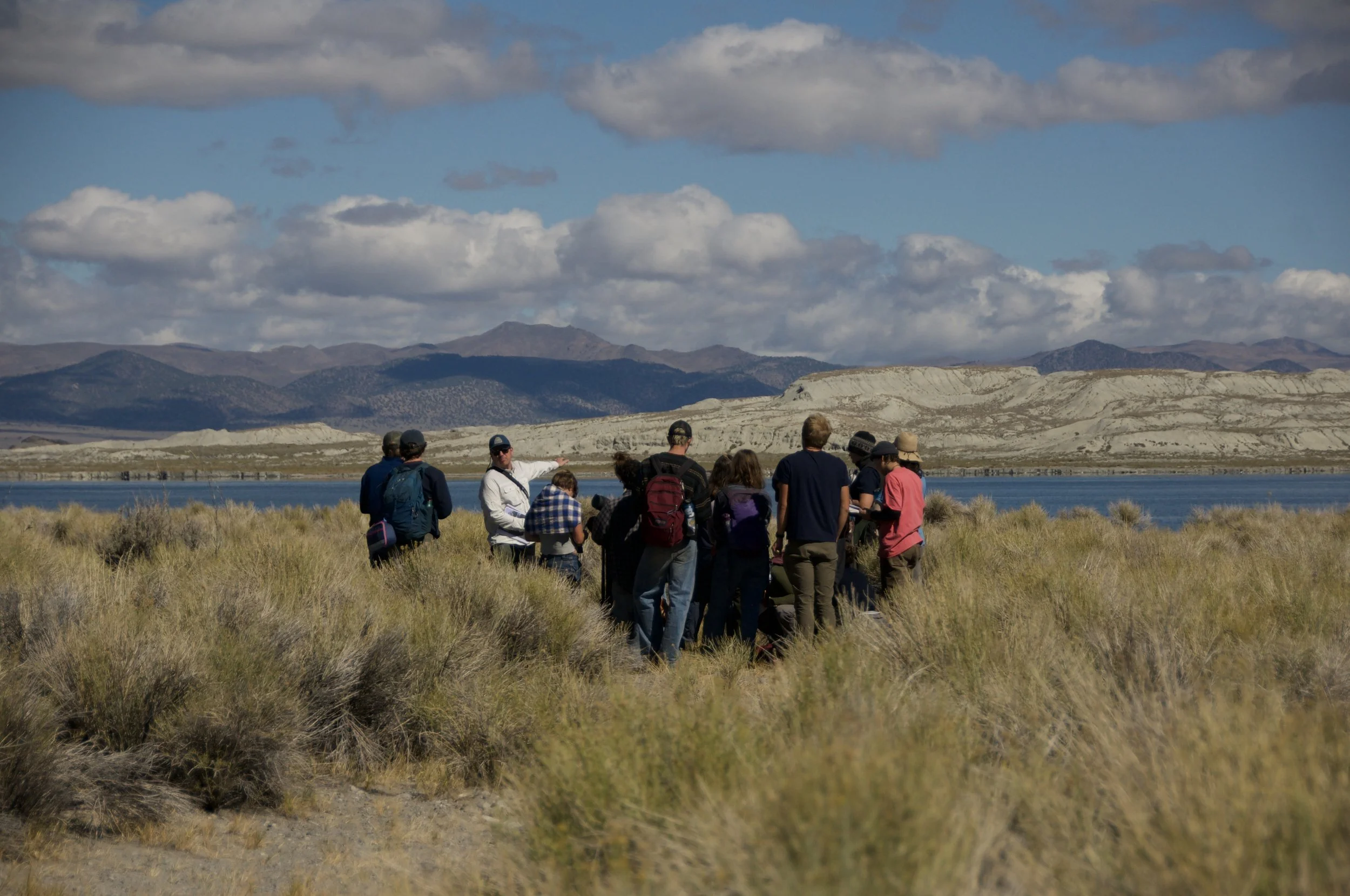
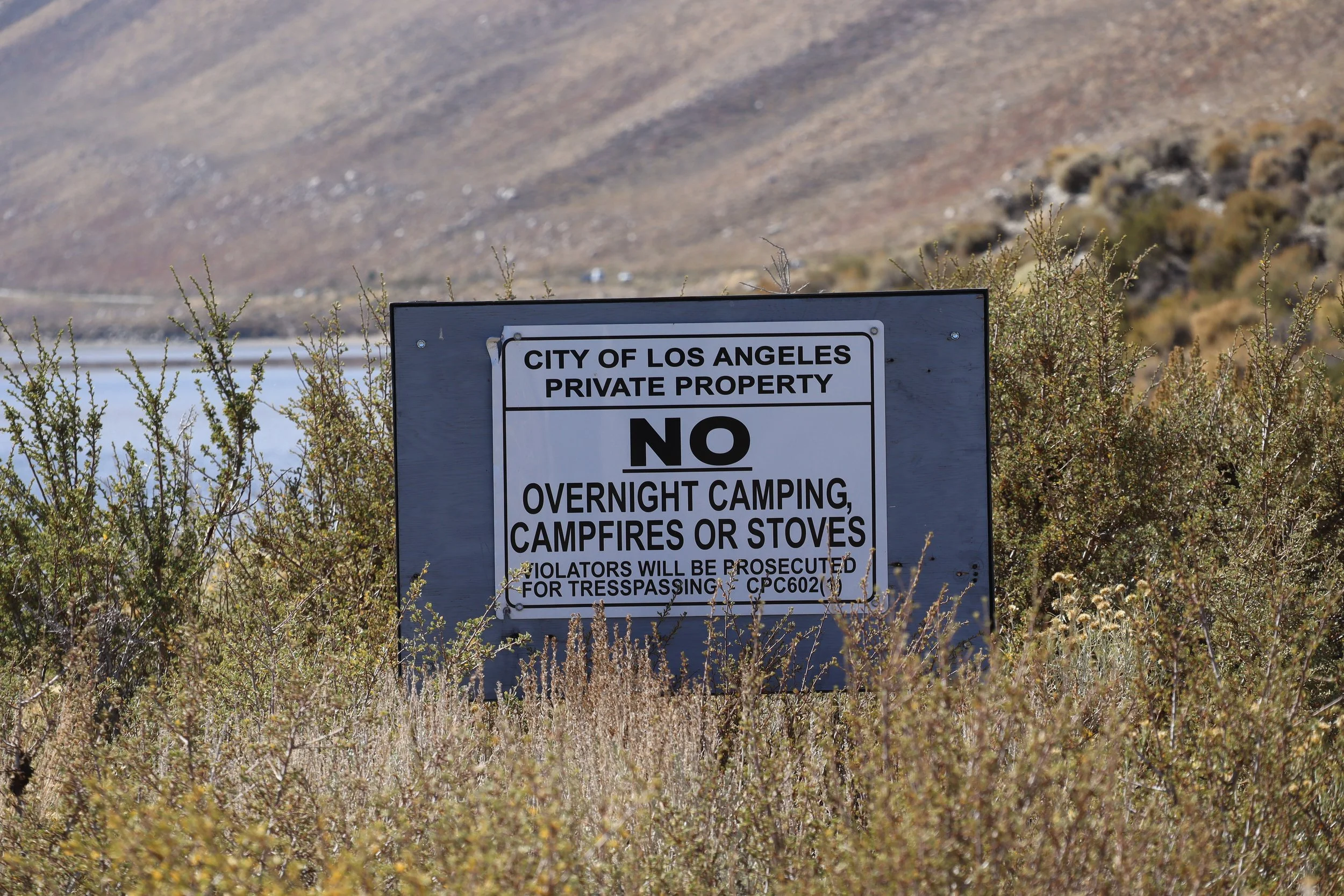
Mono Lake, situated just north of Lee Vining, California, was crudely belittled by Mark Twain as a “solemn, silent, and sailless sea,” nothing but a sedentary, salty divot in the landscape, written off as lifeless and lonely. Nestled in a closed basin encased and surrounded on all sides by mountains, it is easy to view as water in complete isolation. Mountain snowpack percolates into the landscape through a series of creeks, and is then confined to the borders of the lakebed where it accumulates in a concentrating chemistry of freshwater, salt, and a variety of chlorides, carbonates, and sulfates– its only escape evaporation. Fueled by rhetoric which mirrors the prose of Twain, Mono Lake water– deemed useless and disconnected where it naturally lies– has been extracted in mass by the Los Angeles Department of Water and Power. Beginning in 1941, diversions from the creeks which sustain Mono have continued to feed the LA aqueduct– a 419 mile system of pipelines, tunnels, and canals which displaces water from the lake all the way to the heart of the city. The foremost section of the pipeline cuts straight through the base of the Mono Craters, manufacturing a network of connection which violently carves through the landscape. In turn, the lake level at Mono has continued to drop for the sake of watering an arid city hundreds of miles away. In ways such as this, humans view connection as an extractive monopolization of resources, one which strips lake ecosystems of their sovereignties.
I am positive that Twain, and the policymakers which echo his ignorant sentiments, did not see the birds. My assuredness is founded in part due to the misalignment of the date of his visit with documented Wilson’s Phalarope migratory patterns to Mono. If you are lucky enough to find yourself audience to a murmuration of these shorebirds– a synchronized dance in which the flock ebbs and flows, tracing waves in the air– you will know without a doubt that the Phalaropes are water with wings. The salinity of Mono does not reduce it to an aquatic graveyard, but rather infuses it with the ability to host life adapted to its unique conditions, like the Wilson’s Phalarope. These shorebirds sit atop spindly black legs, sporting a slender bill and a muddled array of black, grey, russet, and white plumage which mirror the granitic faces of the looming Sierra Nevadas defining the western edge of the Mono Basin. The lake is a kind of “gas station” for the phalaropes along their migration from Canada to Argentina, a rest stop where the birds double their fat reserves via feasts on the alkali flies and brine shrimp which populate the water. Witness a phalarope hunt and you’ll see the lake come alive, as they circle shallow waters in rapid spirals, animating the surface with little whirlpools from which they pluck their prey with ease. Because the Wilson’s Phalaropes are so entrenched in the cultural ecology of Mono Lake– as well as other alkaline lakes across North America– the species acts as important indicators of alkaline lake health. As they are so highly specialized to inhabit these fragile environments, the rising salt concentrations as a result of diversion pose an undeniably dire threat to their habitat, food sources, and continued existence.
Phalaropes are also physical conduits for alkaline water to forge connections from their separate localities of origins, their migratory paths weaving threads through ecosystems and tying water together across vast distances of time and space. Humans fail to value such connections which migratory birds so beautifully encapsulate. In attempting to confine and consolidate water, as with the LA aqueduct, we overlook and disrupt these ways in which the landscape bonds itself. In reality, the waters of these lakes, including Mono, are far from lonesome. They are intricately intertwined through imaginary aerial riverways, traced by the feet of migratory birds. The sediments wedged and peppered within the folds of their feathers, the larvae digesting in their bellies, and the salt-ridden water droplets coursing through their bodies– these birds tie water together in a manner which can’t be easily conceptualized by the human. This fluvial network manifests not with pipelined and pumped water diversions, but with the bodies of birds. In this way, Wilson’s Phalaropes delicately thread symbiosis across time and space.
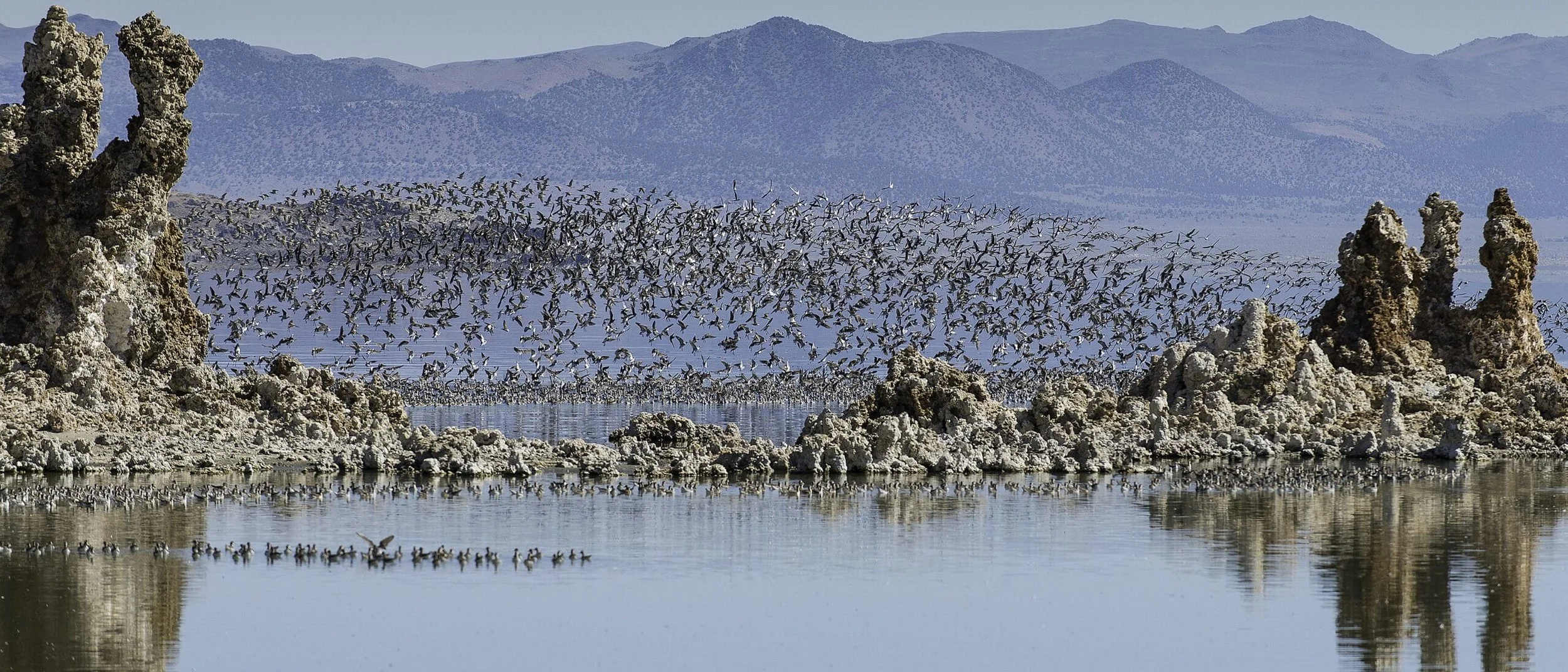
My mind wanders. A flock of Phalaropes materializes before me, gliding in fluid, sinuous unison just above the surface of Mono. I picture this river of birds flowing from one alkaline lake to the next, from Canada to central Argentina. The LA aqueduct suddenly seems an embarrassing attempt at mimicry. How can nature’s model, embodied in the Wilson’s Phalarope– of deep connection across distances without mass, physical displacement– be more at the forefront of our approach to coexistence with water in the west? I am not naively endeavoring to solve these issues of water management with some concrete, ill-conceived solution. Instead, my hope is that, as a collective, our mindset in interacting with water may be transformed. The veins of waterways which weave through our landscapes in these intricacies, far out of the scope of our anthropological understandings, ought to be recognized as what they are: life-giving and immovable. And we can start with respecting the bodies and agency of migratory birds which, physically and metaphorically, carry this water upon their wings.